

KAMBO SHAMAN: NEW TREND OR ANCIENT PRACTICE?
Kambo use outside the Amazon is a relatively recent phenomenon when set against the long history of its application among Indigenous tribes. Two decades ago, only a handful of practitioners existed beyond native communities. Numbers grew slowly for nearly another decade until the first formal trainings appeared. That shift helped turn Kambo into a widely known practice in a short time, with thousands of practitioners now active worldwide. Along the way, many new ideas emerged about how Kambo can be used and what it means to be a Kambo practitioner. Some of those ideas were inspired by tradition; others were shaped by personal experience or belief. One of them is the idea that people who work with Kambo are shamans.
What Shamanism Actually Means
Shamanism is widely understood by anthropologists as one of humanity’s oldest spiritual frameworks, with roots that predate organized religions and reach into the Paleolithic. Archaeological evidence—cave paintings, carefully arranged burial sites, and ritual objects—points to early human efforts to engage the spirit world, seek guidance, and support communal survival. The worldview most often associated with shamanism is animism: the recognition that animals, plants, landscapes, and even celestial bodies possess spirit or consciousness. Within that framework, the shaman functions as a specialist intermediary who can enter altered states and mediate between the human community and non-ordinary realities.
The English word “shaman” entered Western languages through Russian ethnographers in the 17th century. It derives from the Tungusic šaman, used by the Evenki people of Siberia. Many scholars link it to a root meaning “to know,” underscoring the shaman’s role as a person of specialized knowledge and insight. Other linguistic hypotheses connect it to Sanskrit sramana (wandering ascetic or seeker of truth) or deeper proto-Indo-European sources. Whatever its linguistic origin, “shaman” has become a broad label applied to diverse spiritual practices worldwide, a generalization that can obscure important cultural nuances.
A standard anthropological definition, reflected in sources such as the Encyclopædia Britannica, centers on a religious specialist who deliberately enters trance or altered states of consciousness in order to communicate with the spirit realm on behalf of others. Core elements frequently include a rigorous calling or initiation, prolonged training under elders, periods of isolation and fasting, and mastery of techniques, often involving entheogenic plants, chanting and intense physical hardship.
Amazonian Shamanism
In the Amazon regions of Peru, Brazil, Colombia, and Ecuador, Indigenous groups including the Shipibo-Conibo, Huni Kuin, Cofán, Shuar, and many others maintain complex spiritual and healing traditions frequently centered on ayahuasca and other master plants. These traditions share certain features yet differ markedly in ritual form, cosmology, and emphasis.
Importantly, the word “shaman” is not traditionally used in their languages. It is a foreign label. Practitioners have their own terms that describe specific competencies. In Spanish-speaking areas one commonly hears ayahuascero (someone skilled with ayahuasca), curandero (healer), vegetalista or naturista (specialist in plant or natural medicines), tabaquero (tobacco specialist), toesero (Toé specialist), or palero (one who works with the spirits of trees or palos). A single person may master several of these domains. The essential skill is not only technical knowledge of preparation and dosage but the capacity to relate to the spirit of the plants or elements involved.
Other categories exist as well: those engaged in espiritismo (work with the spirits of the deceased) and brujos (those who use spiritual means for harm). All of these fall under the broad Western umbrella of “shamanism,” yet local people often draw clear distinctions among them. Some traditional healers explicitly reject the Western label “shaman” precisely because it is too vague and carries connotations that do not match their own understanding of their work, while others have embraced it and use it when speaking with foreigners.
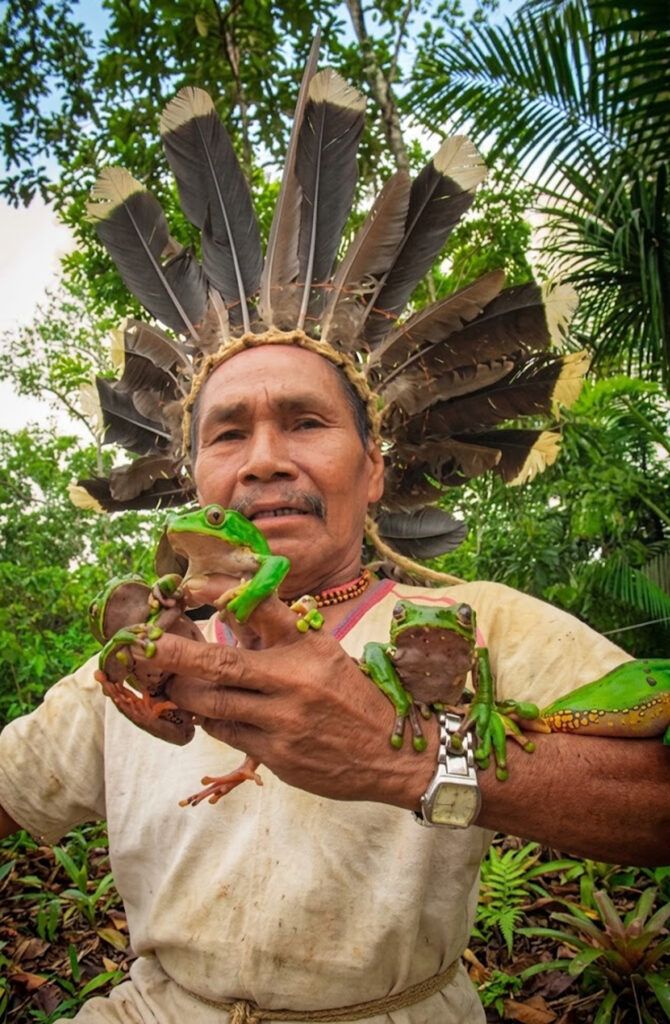
While most Amazonian groups with shamanic practitioners work with ayahuasca or other entheogens, a smaller number of tribes, mainly in Brazil, also use Kambo. The Matsés stand out in this discussion because they use Kambo but do not work with ayahuasca. Tobacco has traditionally played a role among them for visionary purposes, spirit expulsion, and medicine, yet there are no formal tabaqueros comparable to those in other traditions. Spiritual elements are definitely present in Matsés practice, but their approach to Kambo is highly pragmatic: it is used for hunting preparation, physical strength, purification, and resilience. Whether this fits the classic anthropological profile of shamanism remains a matter of reasoned debate rather than settled fact.
Why “Kambo Shamanism” Does Not Fit
If we apply the standard definition of shamanism—entry into altered states to mediate with the spirit world—Kambo does not traditionally serve that function. The frog secretion is not an entheogen, nor is it used by the practitioner during the session or ceremony. Kambo produces intense physiological effects: a rapid rise in heart rate, sweating, vomiting, and purging that many describe as a profound physical reset. Some recipients report emotional or spiritual insights, yet this is neither common nor the traditional reason for its use.
Equally important, shamans are not created by the use of any substance. Traditional training is typically a rigorous, prolonged process involving periods of profound isolation, fasting, and mentorship under a teacher. Simply performing a ritual does not confer the role.
Where the Misconception Arises
The confusion is understandable. Some traditional practitioners who work with ayahuasca also use Kambo. Those individuals are, by their own cultural criteria and by anthropological definition, shamans or curanderos. They are shamans who happen to use Kambo among other tools. That is not the same as the existence of a distinct category called “Kambo shaman.”
When outsiders unfamiliar with these distinctions observe a native person who fits visual expectations of a “shaman” applying the frog secretion, it is easy to conclude that the practice itself is shamanic. From there the next step is often imitation of external markers—feathers, mapacho smoke, ceremonial clothing—without the underlying training, relationship to nature, or cultural accountability. The parallel is straightforward: observing a physician in a white coat with a stethoscope and then acquiring those items does not make one a doctor. The years of study, supervised practice, and ethical formation are what constitute the profession.
Appreciation, Appropriation, and the Problem of Pretending
Respectful interest in Indigenous knowledge is not inherently wrong. Cultural appreciation—learning with humility, acknowledging origins, and supporting source communities—can be constructive. Cultural appropriation becomes problematic when external markers are adopted while the substance, discipline, and accountability of the original tradition are discarded, or when outsiders claim titles and authority they have not earned within any living lineage.
Parts of the contemporary Kambo community include people who present the simple act of applying the secretion as a shamanic practice or who imply that performing it confers shamanic status. Newcomers can easily absorb the idea that they are participating in, or becoming part of, a shamanic tradition simply by receiving or learning to apply Kambo. That idea is not supported by the historical or cultural record.
Neo-Shamanism and Its Consequences
The broader context is the rise of what scholars and practitioners often call neo-shamanism: practices that borrow forms, language, and aesthetics from Indigenous traditions while operating largely outside those traditions’ structures of initiation, transmission, and community oversight.
A related pattern is the rapid self-identification as “shaman” after limited exposure to the medicine or rituals. Because the term is unregulated, anyone may adopt it. This creates two interlocking problems. First, charlatans may use it to attract clients and gain status. Second, the credibility of genuine traditional practitioners is eroded. Suddenly anyone who can buy feathers, a drum, and blow mapacho smoke appears qualified. Imagine if anyone could call themselves a doctor and practice medicine without training. Trust in the profession would collapse quickly.
Authenticity and Energy
Traditionally it is believed that there is an energetic transmission from the person applying Kambo to the person receiving it. Practitioners who intend to heal and help others would do well to aim at becoming genuine curanderos—true healers—rather than performers of a role. Pretending transmits the energy of deception in a world that already has more than enough of it.
While there is no such thing as “Kambo shamans,” there are authentic shamans and curanderos who work with Kambo. All modern Kambo practitioners can only benefit by incorporating their wisdom into their own practice.