

KAMBO EXTRACTION: THE HIDDEN PAIN
What really happens when this sacred medicine is harvested and how we can do better
According to one Matses legend, there was once a time when frogs lived and spoke like humans. At a gathering, one frog stood proudly and declared:
“Look at me. I am strong. My sweat holds great power. Whoever uses it will become strong and a great hunter.”
A young Matses man named Tumi heard this and grew curious. The frog instructed him to tie it up, scrape off its sweat, burn his skin with a tamishi vine, and apply the secretion. Tumi followed the instructions. The effects were intense and frightening at first, but they soon passed. He returned to his village transformed and shared the experience with his tribe.
Other Matses elders trace the knowledge to neighboring groups such as the Marubo. The exact origins remain unclear, yet the traditional harvesting method is well documented. Whether the frog or a neighboring tribe first revealed the secret, the process is the same: the frog is stretched into an X-shape and tied by its limbs to four wooden stakes. If the secretion does not appear quickly, a light tap on the head or pressure on the toes encourages release. Some harvesters place a blade of grass in the frog’s nose, while certain tribes, such as the Matis, place hot charcoal beneath the frog to increase stress and yield.
These practices are ancient and rooted in the lived reality of Amazonian peoples.
Understanding the Cultural Context
To many outsiders, these techniques may appear harsh. Yet judging them solely through a modern Western lens misses important context. The Matses and other Amazonian tribes are traditional hunters whose survival has long depended on the animals around them. Cultural morality determines which animals may be killed for food and which may not. In many parts of the world, cows, pigs, and chickens are routinely consumed. In others, frogs are eaten without hesitation.
It should not seem strange that the same frogs that provide Kambo might also be consumed as food if they were safe to eat. If it is acceptable to kill an animal for nourishment, why would it be unacceptable to tie one temporarily and collect its secretion for medicine?
The Matses relationship with animals is direct and shaped by necessity. They are renowned hunters, and in their culture the line between pet and food can be very thin, as with monkeys for example. The modern romanticized idea that these frogs are treated with special reverence above all other animals is largely incorrect.
For deeper insight into Matses culture, Peter Gorman’s book Sapo in My Soul remains one of the best introductions available.
The Modern Reality
For generations, Kambo use was limited to a small number of tribes, so relatively few frogs were harvested. Even today, traditional use within these communities would not pose a problem. Unfortunately, that balance has shifted dramatically.
As interest in Kambo has grown worldwide, so has commercial demand. The Matses and many other individuals across the Peruvian Amazon are the primary suppliers. Large bulk orders are common. Frogs are becoming harder to find, and those that are located often have little or no secretion left. Visible signs of harm are increasingly common: marks from tight synthetic strings, scratches, and scars from sharp scraping tools.
Some harvesters use softer natural ties and gentler techniques, especially when observed. However, most extractions take place in private, far from public view. Almost everyone claims, “No frogs were hurt.” Yet one does not need to be an expert to see the contradiction: it is impossible to have truly ethical Kambo while simultaneously finding growing numbers of frogs bearing clear marks of harm.
When physical evidence of stress or injury is present, the claim of ethical harvesting becomes difficult to accept at face value.
Who bears responsibility for the current situation?
In truth, all of us who use or purchase Kambo.
Years ago, occasional sticks arrived with traces of blood. Buyers rejected them outright, and the practice largely stopped. That collective response proved a simple truth: consumer standards directly influence what happens in the jungle.
Today, competition focuses on who sells the cheapest sticks and which contain the most medicine, not on which were collected most ethically. Even though most people want the medicine to be gathered responsibly and believe the stories they are told, the only way to truly know how it was collected is to see the process with one’s own eyes. When price is prioritized over ethics, the frogs inevitably suffer.
Unlike Brazil, where the commercialization of Kambo secretion is prohibited and restricted to traditional use within indigenous communities, Peru currently has no such regulations. Many individuals with no native connection, and who do not even use the medicine themselves, have begun collecting it purely for sale. Shops in popular tourist destinations known for “shamanic medicine markets” often offer sticks that may have been collected by these individuals, even if the sellers claim otherwise.
Until recently, thousands of Kambo sticks were shipped out of Peru each year, often to be resold at higher profit. This has become more difficult since the government officially banned exports, though enforcement remains imperfect. It represents the first visible regulatory response to a growing problem. Whether stricter measures will follow remains to be seen.
The Solution
Pointing out what is wrong is only half the work. The other half is showing how we can do better.
Over the years, various practitioners and harvesters have experimented with gentler approaches, but they never caught on. This was mainly because of practicality and the greater quantity of medicine one can collect when the frog is more stressed. One of those methods has been observed among some Brazilian indigenous groups and involves harvesting without tying the frog at all.
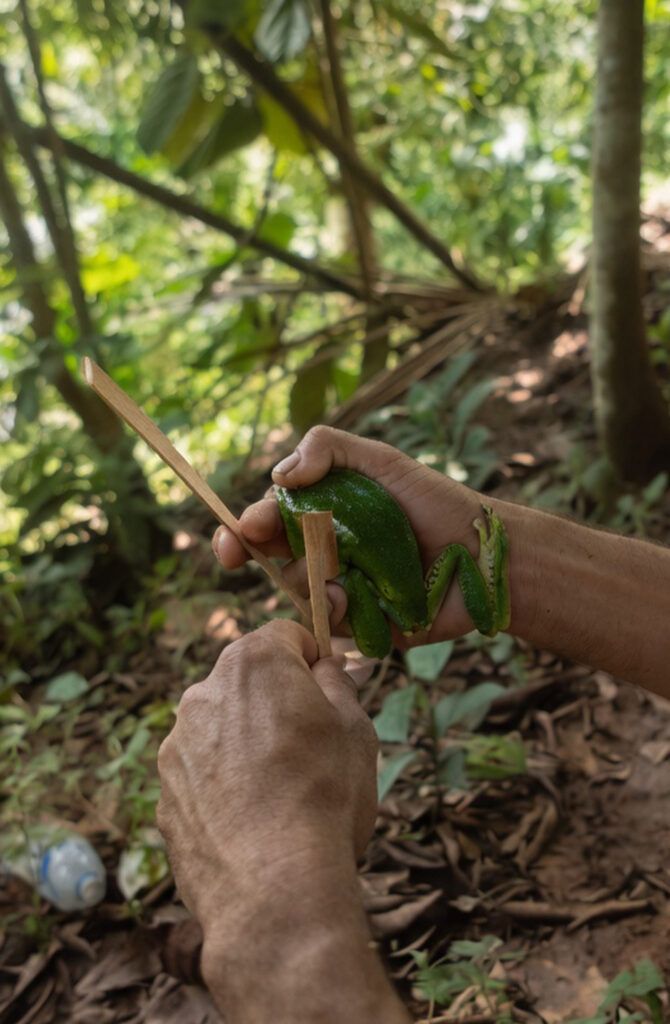
We were inspired by this gentler approach. Building on that idea, we developed and now use the following method: the extraction takes place gently in the hand using a rounded, thicker wooden scraper that is gentler on the skin. Each stick is labeled with the date and a unique identifier, and the entire process is video recorded so the method can be verified.
This approach eliminates many sources of stress and removes any ambiguity about how the medicine was obtained. This is exactly what we have started to do, showing that high-quality Kambo can be collected with significantly less impact on the frogs. We hope to inspire others to do the same, so that this method becomes the new standard.
Why This Matters
While no single method is perfect, and challenges remain in scaling ethical practices across the entire supply chain, this direction represents meaningful progress. The key is transparency. This allows buyers to see exactly how the medicine was harvested rather than relying on unverified claims.
Kambo is a powerful and valuable medicine. Its growing popularity is understandable. Yet popularity without responsibility risks turning a sacred traditional practice into another commodity extracted at the expense of the very creatures that provide it.
Greater awareness among users, practitioners, and suppliers is essential. When buyers consistently choose and support transparently harvested medicine, the incentive structure in the jungle shifts. When practitioners demand better sourcing and share what they learn, standards can rise across the board.
Change is possible, but only if enough people care enough to insist on it.