

EVERYTHING YOU NEED TO KNOW ABOUT KAMBO PEPTIDES
In the Kambo community, you hear the word “peptides” everywhere. Practitioners talk about them as the active force behind the effects and benefits from Kambo. But if you are new to this topic and do not have a background in biology, physiology, or any other related area, it happens often that individuals will nod along when the practitioner talks about it but may not fully understand what it really is and how it works.
I want to use this blog to help you understand in detail what it is, the mechanism behind it, and anything else that may be of importance. Note that research on Kambo peptides is ongoing, so information may vary across studies. This explains why details can differ from one source to another, and new findings could update or challenge what we know today.
What Are Peptides and How Do They Work?
Peptides are short chains of amino acids. Those are organic compounds composed mainly of carbon, hydrogen, oxygen, and nitrogen. We have in total 20 different amino acids of which 9 are considered essential and 11 non-essential. That means 11 amino acids our bodies can produce on their own, while the other 9 we have to obtain from the diet we eat. That’s why they are essential. The amino acids are the fundamental building blocks of proteins and, consequently, life itself as they are directly related to the repairing of tissues, breaking down food, performing vital bodily functions, and much more.
The 20 amino acids can be seen just like the individual letters of an alphabet. And just like how a word is created when multiple letters conjoin, similarly when multiple amino acids bind, instead of words they create peptides that carry instructions for important mechanisms in the body.
Any combinations between 2 and 50 amino acids linked together we call peptides, or a short chain of peptides, while a long chain of peptides 50+ are known as polypeptides.
A protein consists of one or more polypeptide chains that have folded into a specific, functional 3D shape different to a polypeptide which is a single, linear chain of amino acids.
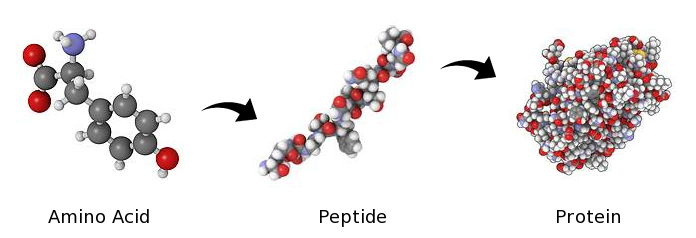
That’s why all proteins are made of peptides but not all peptides create protein. As the number of amino acids linked together increases, the resulting molecule generally becomes capable of greater structural complexity, which in turn allows for more sophisticated and diverse functions. Not necessarily meaning that a protein is superior to a peptide, it simply means they will have different functions. For example, an amino acid is often seen as a basic building block and very direct, peptides on the other hand are quick, precise biological signals or direct-acting agents in the body, while proteins handle coordinated, multi-step, highly regulated, or structural work.
In order for a peptide to trigger a reaction it must first bind to a specific receptor that can be found inside or as well outside of a cell. A cell can be seen as a big factory facility that has many different sections and functions, surrounded by a membrane that holds everything together.
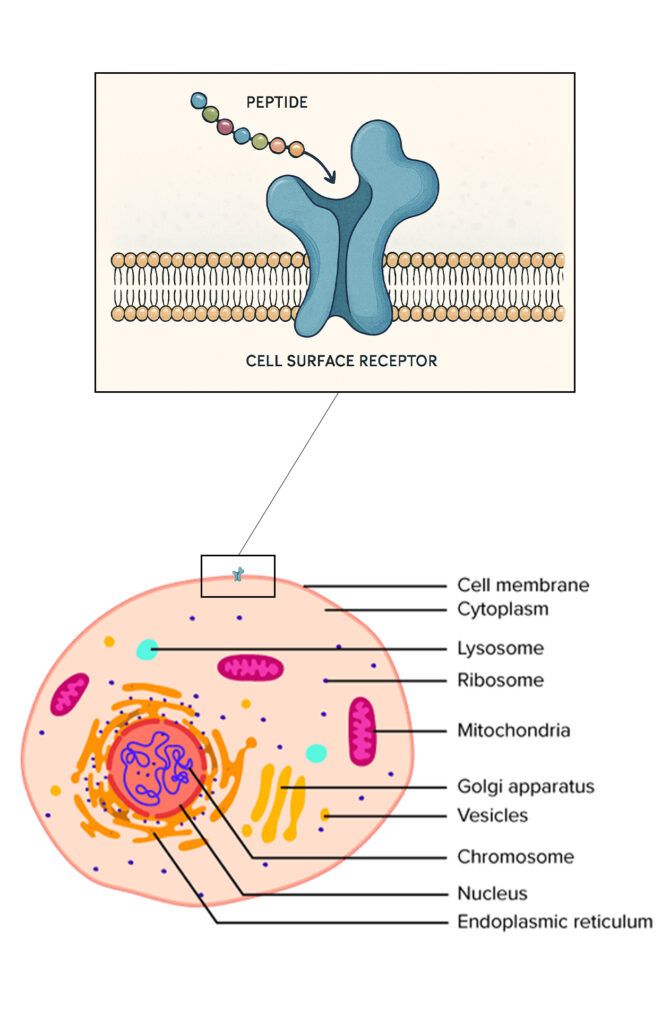
The receptors can generally be seen as locks that only open if the right key goes in, known as a ligand, which is the messenger molecule that floats inside the body until it finds its matching receptor which then triggers a cascade of intracellular events leading to the biological response.
The ligand that binds to the receptors inside the cell are small, fat-loving (hydrophobic/lipophilic) molecules like steroid hormones, thyroid hormones, vitamin D, or retinoic acid. While those that bind outside the cell are water loving (hydrophilic) molecules like almost all natural bioactive peptides including the Kambo ones. Those molecules that bind outside of a cell give very quick effects, taking seconds or minutes and are short lived while those that bind inside are slow and give longer lasting effects that may go for many hours or days.
Peptides offer a rare combination of precision, potency, natural compatibility, and rapid clearance, letting us influence physiology with messages the body already understands, different to drug therapy that interacts with multiple targets across the body, flood systems, block or activate entire pathways, or hit off-target sites, which can lead to strong effects but also more side effects.
Because of this we see also a relatively new form of treatments known as peptide therapy. These treatments are often administered through injections, as this ensures that the peptides are absorbed directly into the bloodstream with a wide range of benefits depending on their type. Which may include improvement of: immune system function, skin health, muscle growth, gut health, inflammation in the body, hormone imbalance and many more.
Kambo Peptides
The skin secretion of Phyllomedusa bicolor (the giant monkey tree frog) contains a complex cocktail of bioactive compounds, of which peptides make up roughly 7.5 % of the dry weight. Some scientific literature has characterized at least 16 distinct peptide sequences from the skin secretion of Phyllomedusa bicolor, though the exact count can vary by study and sample, this is why the current overall number adds up to 28 or more, and new sequences keep emerging with better tech.
The Discovery
Italian pharmacologist Vittorio Erspamer and his team began isolating peptides from amphibian skins in the 1960s. They published the first structures from Phyllomedusa in the late 1960s and 1970s (phyllokinin in 1966, phyllocaerulein shortly after). In the 1980s to 1990s they identified the opioid peptides dermorphin and deltorphins, remarkable because they contain a D-amino acid (unusual in vertebrates) that makes them extremely stable and potent.
Peter Gorman’s writings in the 1980s brought Kambo to Western attention, and samples were sent for analysis. Today, ultra-high-resolution mass spectrometry and cDNA cloning continue to reveal new sequences. Every new study reminds us how much we still don’t know.
Kambo Peptides and What Science Says They Do
Here are the best-studied ones, with effects documented in animal models and pharmacological reviews
- Phyllocaerulein (highest concentration): Cholecystokinin (CCK)-like. Strongly stimulates gastric and pancreatic secretions, gall-bladder contraction, nausea, and vomiting. Contributes heavily to the classic Kambo purge.
- Phyllomedusin (tachykinin family): Contracts smooth muscle in gut and blood vessels. Causes hypotension, increased gut motility (purging), and release of other mediators.
- Phyllokinin (bradykinin-related): More potent than human bradykinin at lowering blood pressure. Causes flushing, increased heart rate, and locally increases capillary permeability, possibly helping other peptides enter the bloodstream faster.
- Sauvagine (CRF-like): Mimics corticotropin-releasing factor. Triggers ACTH and corticosterone release, prolonged hypotension, antidiuretic effects in some models, and behavioral changes in animals.
- Dermorphins (mu-opioid agonists): Extremely potent analgesics, reported 40–1000 times morphine in some assays. Also linked to catatonia, nausea, and euphoria in animal studies.
- Deltorphins (delta-opioid agonists): Highly selective for delta receptors. Analgesic, may contribute to mood effects; unique D-alanine makes them resistant to breakdown.
- Dermaseptins (antimicrobial family): Disrupt bacterial and fungal membranes in vitro. Some (B2, B3) show anti-cancer activity in cell cultures by causing tumor-cell necrosis. Activity against protozoa (Trypanosoma, Leishmania) also documented.
- Adenoregulin: Interacts with adenosine receptors; potential neuroprotective or antidepressant interest in early research.
Less studied peptides include:
- Dermaseptin B: Antimicrobial; kills bacteria/fungi in lab tests.
- Dermaseptin B1: Antimicrobial; similar to B but with tweaks for potency.
- Dermaseptin B2: Antimicrobial and antitumor; inhibits cancer cell growth in vitro (e.g., University of Paris studies, 1990s–2000s).
- Dermaseptin B3: Antimicrobial and antitumor; similar to B2, selective cytotoxicity in cell cultures.
- Dermaseptin B4: Antimicrobial and antidiabetic; may influence insulin pathways in models, but limited data.
- Dermaseptin B5: No specific activities detailed beyond family traits.
- Dermaseptin B6: Antimicrobial; basic microbe-killing potential.
- Dermaseptin G3: Antimicrobial; identified via cDNA, synthesized for testing.
- Dermatoxin: Antimicrobial; frog’s skin defense against invaders.
- Phylloxin: Antimicrobial; shorter chain for quick action.
- Phylloseptin-B2: Antimicrobial; part of the skin’s barrier protection.
- [D-Ala²]-deltorphin I: Analgesic; causes catatonia, nausea, euphoria in models. Delta-opioid selective.
- [D-Ala²]-deltorphin II: Analgesic; similar to I, with nausea/euphoria. Up to 40x endogenous endorphins.
- [Lys⁷]-dermorphin: Analgesic; catatonia, nausea, euphoria. Mu-opioid focus.
- [Trp⁴,Asn⁷]-dermorphin: Analgesic; shorter variant with pain-relief potential.
- New dermorphin I: No specific activities beyond family.
- New dermorphin II: Analgesic; basic opioid effects.
- New dermorphin III: No specific activities detailed.
- Skin calcitonin gene-related peptide (SCGRP): Regulates calcium levels; limited data in frogs.
- Skin peptide tyrosine (SPYY): Antimicrobial; mimics gut hormones.
- Phyllolitorin: No specific activities detailed.
Important note: Almost all data come from isolated peptides tested in rodents, isolated organs, or cell cultures. Very few studies have examined the whole secretion applied transdermally, the exact method used in Kambo treatments.
How Kambo Peptides Are Absorbed During a Session
Kambo is applied to superficial burns (“gates”) created with a glowing stick or ember. The secretion is rubbed into the open wounds and reaches the lymphatic system, then the bloodstream within minutes.
Phyllokinin and phyllomedusin likely increase local blood flow and permeability, aiding uptake. One detailed estimate for a typical 5-gate session suggests microgram-to-milligram quantities of individual peptides enter circulation: roughly 1.6 mg phyllocaerulein, 1.1 mg phyllomedusin, 720 µg phyllokinin, 150 µg sauvagine, 165 µg deltorphins, and only 15 µg dermorphins (trace amounts of many others). These are small but pharmacologically active doses for peptides with high potency.
What Happens in the Body: Trigger, Reaction, Excretion
Once in the blood, the peptides bind their receptors rapidly:
- Gastro-intestinal peptides → intense nausea, vomiting, sometimes diarrhea or salivation (the purge).
- Vasoactive peptides → drop in blood pressure, reflex tachycardia, facial flushing, swelling.
- Opioid peptides → short-term analgesia, possible mild euphoria or inward-focused state.
Effects usually peak within 5–15 minutes and subside within 30–60 minutes.
Peptides are broken down quickly by peptidases (enzymes that cleave amino-acid chains). Half-lives are short, often under one hour, explaining why the intense phase ends relatively fast. Excretion occurs mainly via kidneys after breakdown into smaller fragments or amino acids. No long-term accumulation is expected from a single session.
Kambo Whole Secretion vs. Isolated Peptides
A full Kambo session delivers the entire natural mixture, peptides plus other compounds (proteins, bioorganic amines, steroids, alkaloids, and possibly salts or minerals). This creates synergy we still don’t fully understand. Isolated peptides are being researched for pharmaceuticals (dermorphin analogs for pain, dermaseptins for antibiotics), but they lack the complex interactions of the crude secretion. Conversely, the whole secretion cannot be precisely dosed like a lab compound, which is why individual sensitivity varies so much. The majority of the acute effects can be explained through the peptides.
How Much Do We Really Absorb?
The microgram-to-low-milligram range is enough to produce the well-known acute pharmacological effects. It is probably not enough to explain long-term therapeutic claims at this point, as those claims still remain anecdotal. That’s why most probably not all benefits come just from the peptides. Ritual context, expectation, and the overall the experience likely play also a role in the reported benefits.
Peptide Stability and Storage: How to Preserve Kambo’s Bioactivity
Peptides degrade with heat, light, or humidity, which is why it is best to store Kambo sticks in cool, dark places. Fresh secretion is most potent, but dried forms retain 70–80% activity for years if stored right.
The Promise of Kambo Peptides: Moving Forward with Wisdom and Respect
Kambo peptides are fascinating molecules that explain, with good scientific grounding, the immediate physical reactions most people experience. They are the main reason why the medicine feels so powerful and unmistakable.
At the same time, many of the deeper healing stories shared in circles go beyond what current peer-reviewed data can confirm. That doesn’t make the experiences less real for the people who have them, it just means we still have a lot to learn.
To honor the researchers who’ve decoded the chemistry of Phyllomedusa bicolor, I’ve included links to the original research papers that shaped this blog and our understanding of Kambo peptides.
- Erspamer et al. (1993) – “Pharmacological studies of ‘sapo’ from the frog Phyllomedusa bicolor skin: A drug used by the Peruvian Matses Indians in shamanic hunting practices” (Toxicon) Foundational isolation and quantification of key peptides like phyllocaerulein and dermorphins, linking them to gut and vascular effects. Link: https://www.sciencedirect.com/science/article/pii/0041010193901253 (Abstract free; full text require access).
- de Morais et al. (2018) – “Ayahuasca and Kambo intoxication after alternative natural therapy for depression, confirmed by mass spectrometry” (Forensic Toxicology) Mass spectrometry identification of 16 bioactive peptides in a real sample, with molecular details and symptom ties. Link: https://www.academia.edu/85537807/Ayahuasca_and_Kambo_intoxication_after_alternative_natural_therapy_for_depression_confirmed_by_mass_spectrometry (Free PDF download available).
- Nogueira et al. (2022) – “The Amazonian kambô frog Phyllomedusa bicolor (Amphibia: Phyllomedusidae): Current knowledge on biology, phylogeography, toxinology, ethnopharmacology and medical aspects” (Frontiers in Pharmacology) Catalog of all 28 peptides, including sequences and activities, blending lab data with ethnopharmacology. Link: https://www.frontiersin.org/journals/pharmacology/articles/10.3389/fphar.2022.997318/full (Fully open-access).
- Thompson & Williams (2022) – “Review of the physiological effects of Phyllomedusa bicolor skin secretion peptides on humans receiving Kambô” (Toxicology Research and Application) Peptide-receptor interactions, dose estimates, and session effects, emphasizing potency and mechanisms. Link: https://journals.sagepub.com/doi/10.1177/23978473221085746 (Open-access).