

BEST KAMBO TRAINING: EVERYTHING YOU NEED TO KNOW BEFORE CHOOSING A PROGRAM
Kambo trainings, as structured programs for outsiders, are a relatively recent development. Traditionally, Kambo use varied across Amazonian tribes. Among the Matsés in Peru, anyone respected could apply it to others or themselves, with no formal initiation required. In Brazilian tribes like the Noke Koi, Huni Kuin, or Yawanawá, Kambo often integrated into broader shamanic paths involving Ayahuasca, rigorous dietas, and apprenticeships.
When Westerners first encountered Kambo, some simply observed, asked for permission, and began applying it. Others replicated what they saw without guidance, or simply bought sticks online without any traditional experience. These became the first modern practitioners. As interest grew, especially over the last 15 years, trainings proliferated—from a handful to hundreds worldwide.
I’ve had the privilege of learning early on and observing this evolution firsthand. I never set out to become a Kambo practitioner; it unfolded naturally. I came to the Peruvian jungle for shamanic study—plant dietas with teacher plants as the core practice. Kambo appeared through curiosity, introduced by Pepe, a Matsés elder. My initial “training” was simple: burn, scrape, apply. But I soon noticed it wasn’t sufficient, natives, exposed lifelong and living aligned lifestyles, reacted differently from outsiders. No one taught me about blood pressure drops, fainting, contraindications, or individualized dosing. Those lessons came through direct experience, trial, and respect for Kambo as a shamanic medicine.
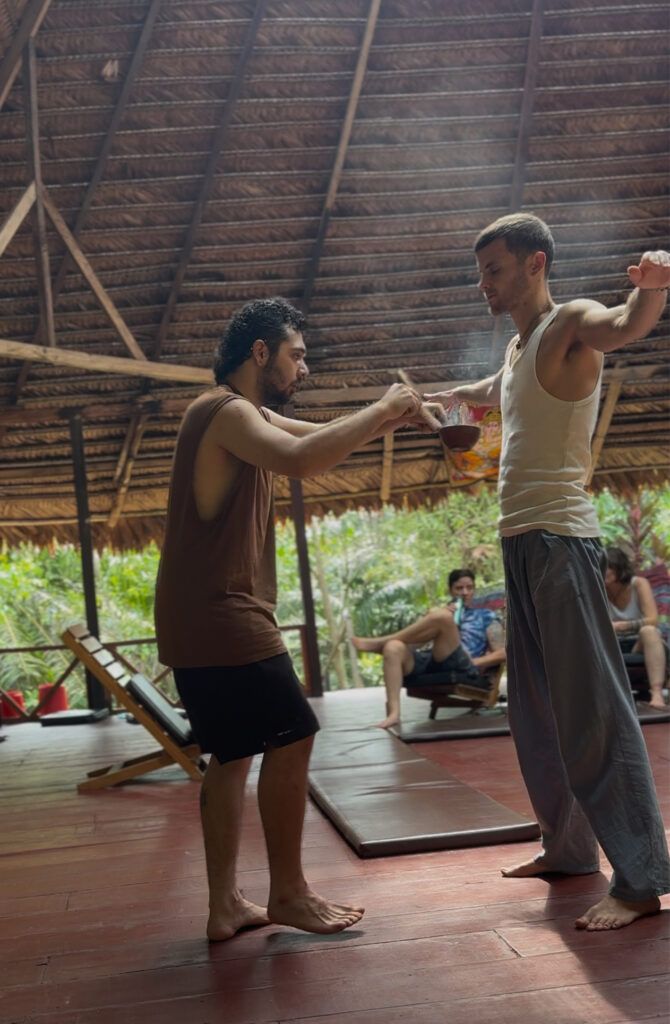
Like other plant medicines, I approached Kambo with the same respect. Following the guidance of my Ayahuasca teacher, I did a dieta with it to gain a deeper connection and it worked. This built a deeper relationship with its essence, which became the foundation of my work and trainings later. Brazilian tribes, because of their Ayahuasca use, are also dieta practitioners (diteros), which may include Kambo dietas. But even some Matsés did so in the past, slightly differently and not always for the same reason. They did Kambo dietas specifically to become better hunters. That’s why, from a traditional perspective, Kambo dietas are essential for those interested in deepening their connection and benefits from the medicine.
Yet views diverge. Some reduce Kambo to bioactive peptides, a chemical trigger for physiological response, treated like a pharmaceutical, with no spirit involved. Others insist protocols with specific points for application, timing of repetitions, and intervals are the key to unlock its full power.
A few claim Kambo is “intelligent” enough to deliver benefits regardless of method. These and other perspectives have shaped trainings over the past decade.
So what truly defines the best Kambo training today?
Safety First—No Exceptions
Safety is non-negotiable. No harm should come to anyone who wants to experience Kambo; knowledge is the key to preventing it.
A major debate persists: Are there real contraindications? Some dismiss them, arguing Kambo works on energies, if one is called to do it, it’s safe and adverse events stem from “unreal” or “unchosen” practitioners. While I honor Kambo’s energetic layer, ignoring physiology is negligent. Most experienced practitioners now recognize contraindications (e.g., many heart conditions, certain medications, problems related to the esophagus, and so on). Lists vary, often as cautions rather than absolutes, while some serve those with “contraindicated” conditions without issue, but surely everyone is different, and taking risks that can cost someone’s life should be avoided.
The most dangerous modern practice is excessive water intake during sessions (3 or more liters). Early respected schools taught this for deeper “cleansing,” but it has caused fatalities via hyponatremia. Many now warn against it, yet some practitioners still promote or practice it.
Dosage can vary hugely by individual sensitivity. Preset “dots” without test applications or observation risk overdose, intense reactions, or worse. Natives often use fixed amounts because of lifelong exposure and similar lifestyles, different from outsiders. The best trainings teach test dots, close monitoring, and adjustment.
Holding space is crucial. Unlike natives accustomed since childhood, many non-natives need guidance through intensity. Practitioners must know how to recognize every step of the process a person is going through and be able to support them properly.
Technique Matters
Efficient preparation of the dots saves medicine and improves sessions, learn flipping to minimize waste, use proper tools, apply correct burn pressure for faster healing. Skillful technique creates smoother, safer experiences for clients, and surely saving medicine helps the frogs too.
Science and Physiology
Natives never asked about chemical breakdowns of Kambo, but modern practitioners benefit from understanding bioactive peptides, human physiology, and how Kambo interacts. Basic knowledge explains contraindications, reactions, and why certain conditions pose risks. Trainings lacking this leave students unprepared, so they may wrongly interpret how Kambo works.
Learn from a Teacher with Real Depth
Your knowledge ceiling matches your teacher’s, you can only learn as much as your teacher knows. Experienced teachers pass solid foundations, with no need for endless trial-and-error. Self-taught paths build wisdom through experience, but only if no harm occurs. Starting with a strong mentor accelerates growth safely.
Beware: Not all teachers know enough, and misinformation from poor ones can, in some cases, bring more harm than self-learning.
What to Look for in a Training (and What to Avoid)
People often prioritize location, length, or cost over the teacher. Convenience matters, but the teacher’s experience, safety record, client numbers served, and years teaching matter most.
- Teacher’s Background → Seek extensive hands-on experience, not just certificates or social media followers. Integrity over branding.
- Location → Jungle immersion offers frog encounters and cultural context, but safety/technique are more important. Beware staged “native” experiences or impersonators exploiting travelers in the Amazon—just because a training is done in the jungle doesn’t mean it is sufficient.
- Length → Burning and applying can be learned in a day, but mastering space-holding, observation, and crisis response takes time. Longer programs provide depth.
- Format → In-person is essential; online trainings lack hands-on practice and safety oversight, often from inexperienced teachers chasing quick income.
- Cost → Higher isn’t always better, but cheap/short programs often cut corners on depth.
- Red Flags → Heavy sales focus, promises of quick mastery, ignoring safety basics, or claiming “no contraindications.”
Jungle trainings sound authentic, but many are basic, lacking modern safety adaptations. The best path combines ancestral wisdom with global experience.
Key Elements Every Solid Training Should Cover
- Thorough contraindications and screening
- Safe water/liquid protocols
- Individualized dosing with test applications
- Precise technique and space-holding skills
- Basic physiology/science of peptides/effects
- Authentic spiritual/energetic connection with the medicine
- Ethics, frog respect, integration support
- Ongoing mentorship beyond the course
My Personal Perspective
After a decade training practitioners, refining our program to integrate these elements, I’ve seen teachers and schools come and go, and I’ve seen what works and what doesn’t. Many students come after insufficient prior trainings: false promises, shallow courses, or profit-driven programs. Stories of exploitation abound in shamanic spaces. A practitioner training should prepare you to be a practitioner—there shouldn’t be any need for another training, which doesn’t mean one can’t take another course to continue deepening their understanding of Kambo. But if you successfully complete a Kambo training and still don’t feel prepared, or you have to ask people you don’t know in Kambo forums for guidance, it surely means your training wasn’t sufficient.
This post aims to illuminate the path. If you’re seeking authentic Kambo training, prioritize safety, depth, experience, and integrity. Not every training is the same, and it really matters a lot with whom you train.
With respect for the medicine and those it serves.